|
On completing this section, you should be able to:
 |
outline normal development of the respiratory
system |
 |
explain the role of surfactant |
 |
describe the changes that occur in the
respiratory system at birth, enabling it to begin functioning |
 |
note the more common developmental abnormalities
of the respiratory system |

The first breath taken by the baby at the time of
birth is a dramatic event. Before birth, the baby obtains the oxygen
it requires by diffusion across the placenta from the maternal blood
to the embryonic (later: fetal) blood. Carbon dioxide produced
during metabolism in the baby is removed by diffusion in the
opposite direction. But at birth, the respiratory system must take
over these functions from the placenta, quickly and effectively ...
Key points:
 |
the respiratory system begins to develop (at the
end of week 3) as an endodermal outgrowth from the pharyngeal
gut, and later receives contributions from cells of the
splanchnic mesoderm |
 |
the outgrowth splits caudally to form two lung
buds which grow down into channels between the thorax and
abdomen - the pericardio-peritoneal canals - which lie dorsal to
the septum transversum. (The pleural cavities are closed later -
this is a complicated process that does occasionally go wrong.) |
 |
the primary bronchi bifurcate repeatedly until
some 23 generations of branching are produced, a process which
continues after birth. |
Lung maturity and surfactant
Lung development is usually adequate by the 7th month
to support life outside the uterus. One of the critical factors in
this process of maturation is the production of a substance within
the lung called surfactant. This detergent-like substance
reduces the surface tension of the fluid lining the alveoli, and
allows them to stay open - without surfactant, the surface tension
is high enough to cause collapse of the alveoli. This happens in
very premature babies, greatly reducing the surface area available
for gas exchange, and in the resulting struggle to breathe damage is
done to the pulmonary epithelium. The accumulation of debris within
the airways produces the condition known as hyaline membrane
disease.
Removal of fluid
Before birth, the lungs are full of fluid. Most of
this fluid is produced by the lungs themselves, but some consists of
amniotic fluid drawn into the airways when the fetus practices
breathing movements before birth. During birth, much of the fluid in
the respiratory tree is expelled as the chest squeezes through the
narrow birth canal. The remaining fluid is removed by the baby's
pulmonary circulation and lymphatic system after birth.
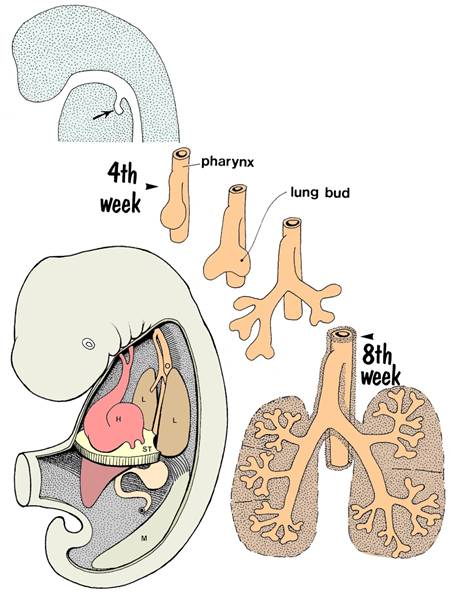
Formation of respiratory system
- L = lung, H = heart, ST = septum transversum, M = mesonephros

Important abnormalities

 |
oesophagotracheal fistula - an abnormal
communication between the oesophagus and trachea |
 |
congenital cysts of the lung - dilation of the
ends of bronchi to form cysts. |

Questions on the respiratory system
1 From which germ layer is the lining of the
respiratory airways derived?
2 From which germ layer(s) are the remaining tissues
of the lung derived?
3 From which part of the gut tube does the
respiratory system originate?
4 When does it become apparent that the right lung
will have 3 lobes and the left lung 2 lobes?
5 How are the pleural cavities formed?
6 What is the origin of the fluid in the developing
respiratory system?
7 Why do very premature babies have difficulty in
breathing? |